- Pop Base
- Posts
- [INTERVIEW] PLAVE: “Caligo Pt.2,” Prejudice Toward Virtual Idols, and Fan Q&A
[INTERVIEW] PLAVE: “Caligo Pt.2,” Prejudice Toward Virtual Idols, and Fan Q&A

Pop Base
April 28, 2026


[INTERVIEW] PLAVE: “Caligo Pt.2,” Prejudice Toward Virtual Idols, and Fan Q&A
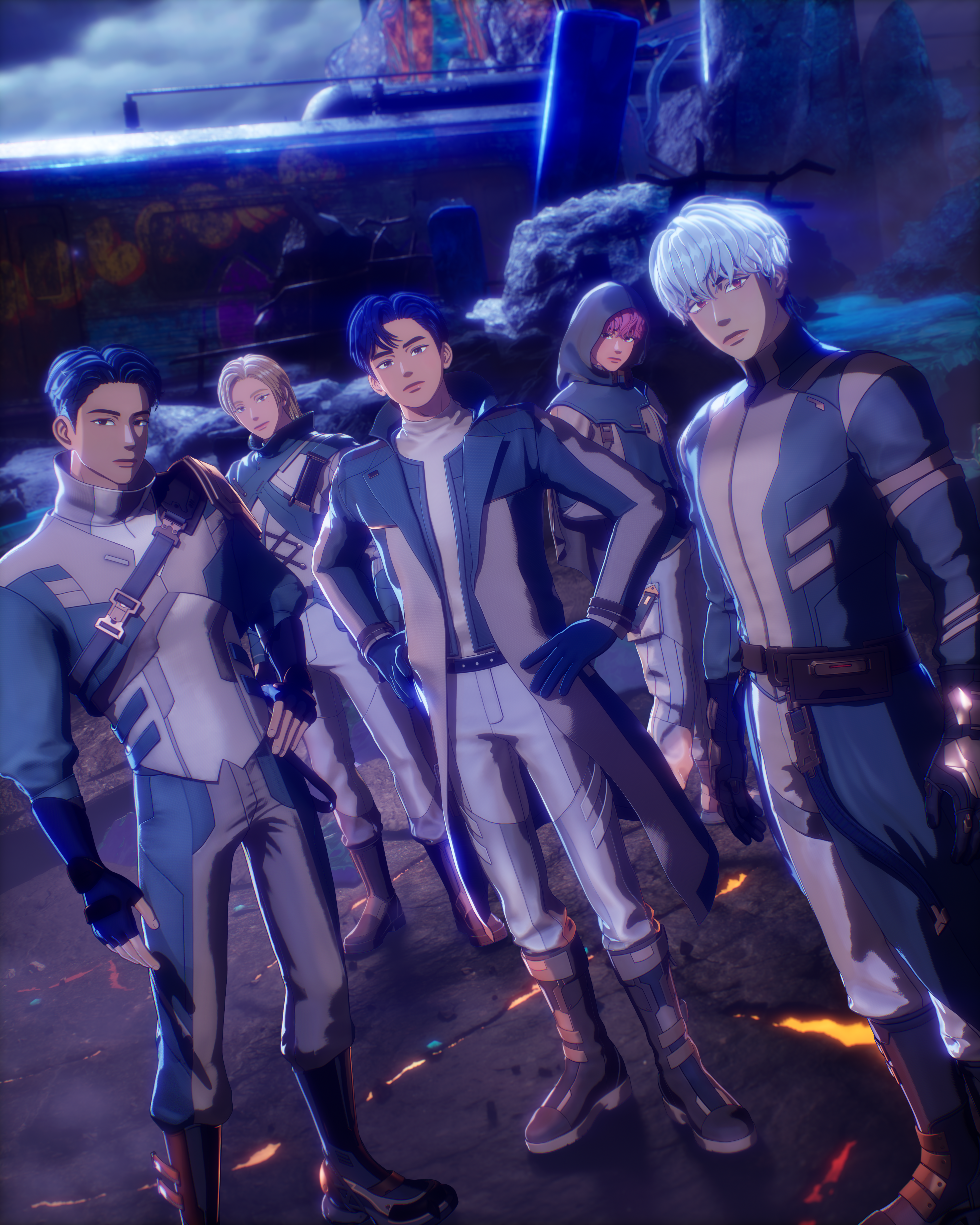
From left: Hamin, Noah, Yejun, Bamby, Eunho. Concept photo of “Caligo Pt.2” Photo courtesy of VLAST.
On February 3, 2025, PLAVE released their third mini album, “Caligo Pt.1,” featuring “Dash,” which debuted on the Billboard 200 at No. 195, making them the first-ever virtual K-pop group to enter the chart. Despite this success, the album ended on a pessimistic note, as the PLAVE members appeared to collapse and lose their fight against Caligo.
PLAVE are not only a self-producing K-pop group—a term used for idols who actively participate in the writing, composition, and/or production of their music—but also storytellers.
The Caligo series opened a new chapter in their multi-year lore, introducing Caligo, a shadow-bound force that emerges from the wider world of Caelum, pulling the forgotten toward the void at the edge of existence. Beyond the fictional narrative, however, the antagonist carries a deeper meaning: “[…] everything that puts us in a vulnerable position, such as negative perceptions based on appearances or prejudices toward virtual artists,” PLAVE leader and main vocalist YEJUN told Pop Base.
Now, nearly 14 months later, PLAVE return with “Caligo Pt.2,” the second and final installment of the Caligo series. The release landed the group at No. 145 on the Billboard 200, earned them a debut at No. 75 on Billboard’s Artist 100, and brought the Caligo series to a victorious close.
In this interview with Pop Base, PLAVE talk about the process behind creating “Caligo Pt.2,” navigating the prejudice toward virtual idols, as well as what it means to be a self-producing virtual idol in the age of generative AI.
“Caligo Pt.1” felt like the start of an unresolved struggle, especially in “Dash,” where your fight against Caligo didn’t end in victory. In “Caligo Pt.2,” how does that battle evolve, and what does “fighting Caligo” come to represent for you now, especially in terms of resolution or transformation?
YEJUN: That’s right. In “Caligo Pt.1”, all of us collapse, and it ends with HAMIN becoming enraged after witnessing that. In “Caligo Pt.2”, it begins with an enraged HAMIN facing Caligo on his own. Meanwhile, something unexpected happens to me, and that incident becomes the turning point that allows PLAVE to regain their strength and fight once again.
NOAH: As you can see in the music video, the battle between Caligo and PLAVE comes down to a fierce and intense clash, ultimately ending in PLAVE’s victory. In Asterum, there is no sun, but the city glows yellow as if the sun has risen, bringing the story to a close.
BAMBY: The fact that the Caligo series comes to an end with this album feels like both a conclusion and a new beginning, making us expect the new chapter as well. It evokes curiosity about what kind of story we’ll return with next.
EUNHO: By the time we reached “Caligo Pt.2” and faced Caligo in a ‘real’ battle, about a year had passed in real time. That period felt like sharpening our blades in preparation for the fight. We wanted to come back with an album even better than the previous one.
HAMIN: And we wanted to show the public how much we’ve grown, which is what this battle with Caligo represents. We worked hard to come back stronger by experimenting with a variety of genres, striving to reveal sides of PLAVE we hadn’t shown before.
How has your creative process evolved between Part 1 and Part 2? Were there any risks you felt more confident taking this time, whether musically or conceptually? Were there specific influences or ideas you intentionally held back then that you’re now exploring more fully in Part 2?
YEJUN: When we were preparing “Caligo Pt.1”, we had just wrapped up the Asterum album trilogy, so there was some pressure about starting a new chapter, like the pressure that we have to make a strong new beginning. I thought that pressure might ease when preparing “Caligo Pt.2”, but then came a different kind of burden, wanting the sequel to live up to or surpass the first. It took a lot of courage to overcome those feelings.
NOAH: “Caligo Pt.1” became a million-seller album and it marked a major career milestone for us. Because of that, we felt a strong desire to bring back something on par with, or even better than, “Caligo Pt.1”. That ambition and pressure definitely made things more challenging. But working through it together as a team, we were able to finally complete “Caligo Pt.2”.
BAMBY: The choreography for “Dash” is already very intense. However, since “Caligo Pt.1” and “Caligo Pt.2” share the central theme of ‘the battle against Caligo,’ and “Caligo Pt.2” represents the climax of the story, we focused on making “Born Savage” even more visually impactful than “Dash.” As a result, while the level of difficulty is similar between the two songs, the choreography for “Born Savage” ended up being much harder to perform.
EUNHO: Musically, we also wanted to show more variety, so we included an a cappella track this time. Since it required a completely different recording approach, it took nearly three times longer than our usual sessions. But once it was finished, we were really satisfied with how it turned out. It felt rewarding, and I remember everyone being excited, realizing that we had grown once again.
HAMIN: I think we made bolder choices this time. There was actually a lot that happened between “Caligo Pt.1” and “Caligo Pt.2”, including releasing two single albums and going on an Asia tour. Those experiences gave us the confidence to take more daring steps without hesitation. That’s how the title track for this album came to be, along with the rest of the songs. There are many tracks on this album that show sides of PLAVE we hadn’t revealed before.
When both parts are considered together, what kind of larger statement or experience do you hope listeners take away from the "Caligo" series as a whole?
YEJUN: Caligo is not only a special force within our universe's lore that threatens us, but also a kind of persona that represents everything that puts us in a vulnerable position, such as negative perceptions based on appearances or prejudices toward virtual artists. Through the Caligo album series, I hope listeners come to see that ‘PLAVE is an ARTIST, too.’
NOAH: Both “Dash” and “Born Savage” are songs about vulnerability and the will that emerges within it. I hope you listen to them back-to-back and imagine your own version of youth; the fragment of youth that may be fragile, but never collapses, and because of that, shines.
BAMBY: I hope you listen to every track on both albums of the Caligo series. They capture exactly how much we’ve grown over the past year, along with the new things we’ve tried. I hope people recognize that we’re self-producing idols who are constantly evolving.
EUNHO: We want to give listeners the feeling of stepping into a grand fantasy narrative. Through these two contrasting albums, I hope you can experience the multidimensional appeal of PLAVE’s music and feel the thrill of escaping everyday life and exploring a new world.
HAMIN: Although both albums are tied together under the overarching theme of ‘the duel with Caligo,’ we’ve actually been building this narrative all along. With this new album, I think you’ll be able to feel the thrill of a puzzle gradually coming together. Like scattered pieces forming a complete story, we hope you’ll follow the narrative we’ve built with sincerity until the end.
If Part 1 was about opening a new chapter, how would you describe the role of Part 2, either in one sentence or in one word?
YEJUN: I’d describe it as a climax. It carries the new chapter we opened in “Caligo Pt.1” all the way to its highlight. Aren’t you curious about the peak of PLAVE’s grand narrative?
PLAVE have built an extensive conceptual universe since the very beginning of your career, with each release expanding and connecting into a cohesive world. Within that, how do you ensure that emotion stays at the forefront and doesn’t get overshadowed by the narrative or world-building?
NOAH: Our universe lore is just a vessel for the story, and the core lies in the message. By focusing on the message, I think we’re able to express our emotions more clearly. Rather than relying on grand settings, we focus on honestly conveying the emotions we share among the members and with our fans, PLLI, through our melodies and lyrics.
BAMBY: I’m really glad to hear that our stories feel emotion-driven. In reality, we focus more on making the music, while our company staff puts more effort into building the universe. Each side works on what they do best, and then we bring everything together afterward. Even though these elements come from different processes, in the end, we’re the ones singing the songs, so I think that’s what allows the emotions to come through first.
After creating your music independently for over three years, some people—especially with the rise of generative AI—still mistake PLAVE for an AI idol group. How does it feel to have your humanity questioned in that way, and how do you navigate that perception personally?
EUNHO: I think people sometimes assume we’re AI because AI feels more familiar to them than virtual artists. Also, there aren’t many opportunities for people to see how we actually work. We’ll continue to work hard and show everyone that virtual artists and AI are different!
HAMIN: I think the misconception that we’re like AI can actually be cleared up quickly if we show our genuine charm. At first, people might think, “They don’t really act like AI,” and then realize, “Wait, they’re actually human?” I believe that kind of twist can be quite appealing, so we’re okay. We’ll continue to share our unfiltered selves and sincerity through things like the sound of us catching breath while dancing, small mistakes during live broadcasts, and our natural laughter.
Answering Fan Questions
What’s the DANLaz process for creating choreography? Do you take time to brainstorm individually first, or do you do it all together?
BAMBY: We usually start by taking time to come up with ideas individually. I tend to put on my AirPods and shape the ideas in my head into something more concrete, or I’ll sketch out movement paths on a board and build the choreography visually.
HAMIN: BAMBY and I have quite different choreography styles. That’s why we each work on our own ideas first, then come together to find what works best. That way, our styles blend naturally into a cohesive and polished routine. We both have a hip-hop base when dancing, but I tend to focus on clean, line-based movements, while BAMBY emphasizes more fluid and sexy elements like wave movements.
Tell us a TMI about the time you produced “Caligo Pt.2,” and why did you choose SOLE as a featured artist?
EUNHO: I’ve always really liked SOLE’s vocal tone, and I’ve been enjoying listening to her releases. While working on the track “HMPH! (feat. SOLE),” I felt that it would be nice to have a female singer featured on the track, and SOLE immediately came to mind. I thought her tone would blend well with all five of our members, so we reached out to collaborate.
What kind of genre does each member feel highlights their singing skills the best? You’re all really versatile, so I’m curious to know what you think of yourselves!
YEJUN: I think pop ballads best deliver the delicate tremble in my voice and emotional nuances clearly. When I deliver the sincerity of lyrics in a simple way, the clear and soft qualities of my vocals stand out the most.
NOAH: Rock or band-driven sounds that let me showcase powerful high notes and strong vocal projection! It feels the most thrilling when I can fully unleash my voice alongside an intense live session.
BAMBY: I think R&B pop with trendy rhythms and a wide vocal range fits me best. My voice has a unique, bright tone that really stands out over groovy beats.
EUNHO: Hip-hop R&B would suit me well, as it allows me to show both impactful rap and rhythmic vocals. It’s a genre where I can best highlight my tight articulation and wide vocal range.
HAMIN: Lo-fi hip-hop or dark R&B works best for me, since both genres maximize my low-register tone, which is one of my strengths. I enjoy grounding a track with a deep, solid vocal presence.
What’s something about being a virtual idol that you find the most rewarding versus most challenging?
YEJUN: What makes me most proud is being able to connect with PLLIs around the world through music without any limitations. On the other hand, the most challenging part is the meticulous process of perfectly synchronizing and delivering even the smallest emotional nuances and facial expressions without error.
NOAH: I feel most proud when we bring magical performances that transcend time and space into reality. The difficult part is not being able to directly share the heat and energy we pour out behind the scenes with PLLIs.
Listen to PLAVE’s 4th Mini Album “Caligo Pt.2” on Amazon Music, Apple Music, Spotify, and YouTube Music.
— Javeria Yousuf
Subscribe to the newsletter to discover new releases through Pop Base weekly and to find out what songs we declare the best of the week.